A Backbeat Is a Place to Listen, Not a Genre
Learn to hear a backbeat by its placement, not its style label, and follow how drums, bass and other accents shape the groove across the bar.
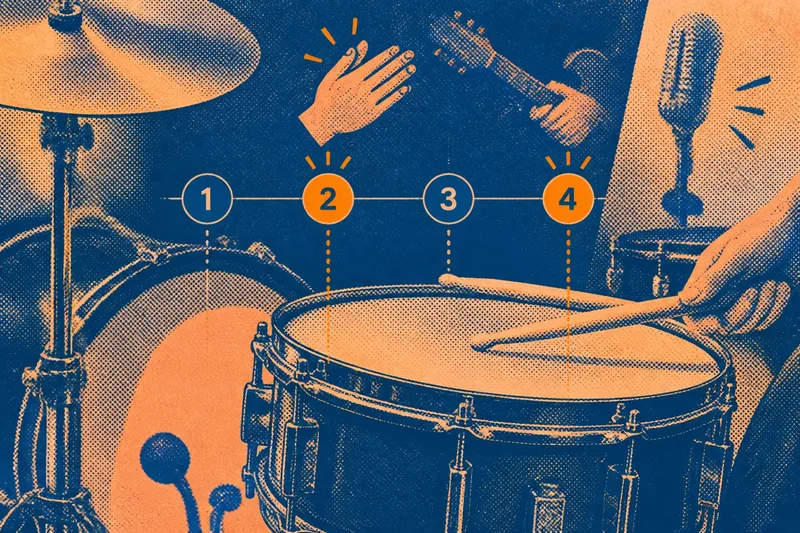
The common mistake is hearing a snare on two and four and deciding the song must belong to a particular style. That shortcut can make you miss the more useful clue: a backbeat is an accent in a particular place, not a genre label. Listen for where the emphasis lands before guessing what kind of music you are hearing.
A backbeat marks the spaces listeners lean into
In many four-beat patterns, the backbeat falls on beats two and four. A drummer might strike the snare there while the kick drum gives weight to one and three. That placement creates a familiar push and pull, but the snare is not the definition: a handclap, rim click, piano chord or group of voices can put the accent in the same spot.
Count a steady “one, two, three, four” while listening. If the strongest recurring accent lands with “two” and “four”, you may be hearing a backbeat. Keep the count loose; the point is to notice the accent’s position, not to turn the song into a counting exercise.
The word “back” can mislead. It does not mean the beat is late, behind the music or always played by a drum kit. It names a customary accent pattern, and musicians can shape that pattern with sound, timing and intensity.
Placement tells you more than the instrument
A snare drum often makes the backbeat easy to spot because its sharp attack cuts through a mix. But the same accent can be softer, rougher or spread across several sounds. A tambourine may flick on the backbeat; a guitarist may chop short chords there; a singer may lean on a syllable in the same rhythmic position.
Try listening in layers. First follow the kick or bass to find the pulse. Then notice which sounds answer or reinforce the second and fourth beats. Finally, listen for accents that fall elsewhere: those may be syncopations, fills or competing rhythmic patterns rather than the backbeat itself.
Imagine an invented recording with a low kick on every beat and a dry handclap on two and four. If a bright guitar adds a chord on the same claps, the backbeat becomes more pronounced without changing its location. You would hear a stronger emphasis at those points, even though the texture has gained another instrument.
One rhythmic feature can travel across styles
A backbeat appears in music with very different tempos, instrumentation and cultural roots. Its presence alone cannot tell you a song’s genre, just as hearing a guitar cannot settle whether a track is folk, pop or something else. Style emerges from a broader set of choices, including phrasing, timbre, harmony, production and the way rhythms interact.
Nor does every backbeat sound equally firm. In one arrangement, the snare may land squarely on the counted beat. In another, the player may place it a little behind the pulse, creating a relaxed feel, or make the accent light enough to blend with the groove. The counted position can remain two and four while the perceived energy changes.
That distinction is handy when a song’s style seems hard to name. Instead of asking whether the backbeat makes it “rock” or “soul”, ask what else is happening around it: Does the bass move continuously or leave gaps? Are the chords sustained or clipped? Do the accents feel heavy, delicate, straight or lopsided?
Listen for the backbeat without assuming a style
Start with the broad pulse, then listen for the accent that returns in the same place across the bar. Once you hear that pattern, notice its sound and feel separately; this keeps an observation about rhythm from becoming a snap judgement about genre.
Can a song have a backbeat without a snare drum?
Yes. The accent may come from claps, a rim click, a chord attack or several sounds working together. Listen for the recurring placement on two and four rather than searching for one particular instrument.
Is every accent on two and four a backbeat?
Not necessarily: a passing accent may occur there without establishing a repeated pattern. Hear whether the emphasis returns across the groove and how it relates to the other beats.
Can a backbeat feel behind the pulse?
Yes. A player can place an accent slightly behind the underlying pulse, giving it a laid-back quality while preserving its role in the pattern. The effect depends on the performance and the surrounding parts.
Does a backbeat identify a genre?
No single rhythmic feature can do that reliably. Treat the backbeat as one audible detail, then consider the arrangement and the other musical choices before describing the style.
Keep the count simple and the ear curious
For a quick listening note, write down three things: the likely pulse, where the strongest recurring accents land, and which instrument or sound carries them. Add a fourth only if it helps: whether those accents feel firm, soft, delayed or unusually sharp. This keeps the observation concrete without forcing a genre verdict.
It is not worth the effort to count every subdivision or debate whether a borderline accent “qualifies” while the song is still playing. If the beat is difficult to follow, tap gently to the broad pulse and return to the accent on another pass. A short, clear observation is more useful than a confident label built on a guess.
When you hear a backbeat, listen for its placement first and its character second. That habit makes the term more precise, and it leaves room for the groove around it to tell its own story.